Personal Uniforms and Equipment
(These standards adhere to the GWA's draft uniform and
equipment regulations of 1999)
"Any unit member serving on the German Staff is required to maintain
a separate
junior enlisted impression in the event that of higher rank is not
needed for that event."
Field Cap (Feldmütze) The enlisted man's field cap will display the following characteristics: Manufactured of field grey wool. Machine sewn throughout (except for attachment of the lining to the cap body) White Pipings above and below the green cap band of wool The cap band seam shall be at the cap rear. Lining of white, grey, field grey or drab cotton or similar material. Piping(s) not to exceed 4mm in diameter
Enlisted pattern cockades (ca. 1 inch in diameter, attached to the cap via sewing through holes in the center field)
Reich Cockade (black/white/red) centered on the front crown seam between the upper piping and cap band
State (Prussia) Cockade (black/white/black) centered on the front of the cap band.
Field caps for enlisted men may be fitted with a narrow black visor of flexible leather, not to exceed 3 inches in width at the widest point. A black leather chinstrap (of two piece construction) affixed by two plain black buttons would be the norm.
Unteroffiziere and Sergeanten wear smaller (ca.75 in.) lacquered state and Reich cockades on the visored field cap. These are positioned similar to the kurassier's mentioned above
Tunic (Waffenrock): No pictorial evidence supports the wearing of the Bluse by enlisted men in the Kurassiers.
Constructed of field grey wool. "yellow" rimmed crown buttons. Green piping on all exposed edges of the collar, front, bottom, top and bottoms of cuffs. Regimental worsted braid of regimental patternon cuff and collar, flared cuffs, standing collar; piping diameter shall not exceed 4mm. Tail flap arrangement as on original tunics, consisting of vent flaps of two overlapped panels with the top (left) flap edge offsetto the right of the tunic back center line. Cuffs, cuff flaps, and piped "false pocket" flaps on the tail vents must consist of separate pieces of material, piped and mounted to the tunic (i.e., cuffs, etc., may not be "defined" by a line of piping or braid). Skirt pocket flaps on the tunic front must be mounted at a slant. All characteristic seams on the rear of period tunics must be present (i.e., the tunic rear must consist of at least 3 separate pieces with continuous seams extending from the tunic bottom edge to intersect with the sleeve rear seam. Rear "belt ramps" and side hooks of "yellow" must be present Buttonsmust be subdued (chemically darkened).
The standing portion of collars will not exceed 3 inches in height. Collars will be equipped with two "hook and eye" fasteners to hold the collar closed The collar will have (inner) buttons to which the "shirt"collar is attached.
The shoulder straps are of the pointed variety (ca. 70mm wide) being field grey with a white underlay and green piping. The regimental cypher (GRV - that of King George V of Great Britain) will be embroidered onto the grey tops. The thread will be red to match the felted applique crown which surmounts the cypher.
Insignia of Rank. (Dienstgradabzeichen) Gold metallic rank braid centered along all regimental braid.
Riding Trousers (Reithose) (Note: these are fuller at the thighs but not so much as the exaggerated type worn by some officers) Made of field grey wool. Must have 2 slanted front pocket slits. Must have an internal watch pocket. Will be cut high waisted and have an adjusting belt with buckle across the rear. The inside of the legs will be reinforced with an additional layer of material (cloth or leather) extending from the bottom of the fly to half way up the seat of the trousers. This reinforcement will extend down along the legs to a point where its endpoint is not visible when boots/leggings are worn
Optional corduroy trousers may be worn by those who already havethe
wool Reithose.
Cavalry Boots (einheits Kavalleriestiefel) Leather construction with rounded, undecorated toe. Dark brown, or black, leather, smooth or rough side out. Soles and heels must be leather; heel irons desired, hobnails permitted. Height between 14 and 16inches along the front of the shaft; the rear of the shaft will be 2-3inches shorter than the front measurement
Ankle Boots (Schnürschuhe—Must be wornwith Leggings) Leather construction with rounded toe; an undecorated toe cap is permitted. Leather may be natural, brown, or black, smoothor rough side out Soles and heels must be leather; heel irons and hobnails desired Boots must be of sufficient height to cover theankle.
Leggings (Gamaschen) Wrap style. Constructed of wool field grey of sufficient length to completely cover area between ankle and knee when worn. Width not to exceed 4 inches Tie or buckle closure authorized.
Leggings (Gamaschen) Leather. Leather construction of two pieces with the seam in the rear. Secured with a leather strap which spirals down the legging to be secured by a buckle near the base. Dark brown or black. Approximately the same height as the stiefel above.
Collar: Constructed of grey, field grey, or black polished cotton or similar material. Attached to the interior of the coat collar by three buttons (on the coat). It must not exceed the height of the coat collar.
Shirt (Hemd) The shirt will belong-sleeved with buttoning cuffs and a small, standing collar. It will be a pullover shirt and will close down the front slit with buttons. The issue pattern will be made of an off-white unbleached muslin or a fabric similar to lightweight denim. Civilian pattern shirts of muted check or stripe patterns, conforming to the basic style of the issue shirt, are authorized.
Knit Items. Acceptable colors for knit garments are shades of gray.
Greatcoat Constructed of stone
grey wool. The sleeves will have turn back cuffs, and the back will
be made of a single, non-seamed piece of fabric. The coat will be
single breasted, and the 6 front buttons and those used to retain the shoulder
straps will be the rimmed crown pattern or tombac, either painted or subdued.
The coat will reach to the wearer's mid-calf. The collar will befitted
with a single hook and eye to hold the collar together when closed.
There will be two slanted hip pockets on the coat front; these will be closed
with a non-buttoning flap. The back will have two belt halves at
waist level; these will be joined at the center of the back by two rimmed
crown buttons and matching buttonholes. The bottom edge will be unhemmed.
Shoulder straps may either match the coat or be made of field grey or grey
green as worn with the tunic. The collar will have a green trapezoidal
patch on either side.
Scarves and toques. Scarves may
be grey or field grey woolen knit. Non-garish civilian pattern scarves,
including muted plaids, are permitted; these may be of woolen knit, wool,
or wool or fur felt. Officers may wear silk scarves. Toques
must be of grey or field grey woolen knit only. Scarves and toques will
only be worn in conjunction with the greatcoat and must be mostly concealed
beneath that garment. The wearing of scarves or toques under the
tunic with the tunic collar open is prohibited.
Steel Helmet (Stahlhelm) Must
be an original helmet constructed of steel (M-16, M-18, or modified
M-18 - so called "cutout"). Both ventilation plugs present/
Liner pins present and visible from the helmet exterior Must have
a functional chin strap. Straps constructed of leather or ersatz
material Chin strap hardware appropriate to the helmet type (i.e.,M-16
type hardware on M-16 helmet). Helmets will be painted grey, field
grey, or olive. No camouflaged helmets can be documented with the 8. Kurassier.
Carbine (Kar 98)
German issue pattern Kar 98 dated prior to 1917. Sling required;
slings may be of leather and/or cloth construction.
Bayonet and Frog (Seitengewehr (or Bajonett) und Seitengewehrtasche)
A. Bayonet: the Kar98 bayonet must have a matching metal sheath. Must be an actual bayonet (i.e., cast or molded replicas are not authorized)
B. Frog: Constructed of natural leather, smooth or
rough side out.
Belt and Belt Plate (Leibbinde (or Koppel) und Koppelschloß)
A. Belt: Constructed of natural or brown leather, smooth or rough side out.
B. Belt Plate: Constructed of tombac with a silvered (Prussian pattern) central cartouche; or of steel or other non-ferrous metal. Tombac plates may be worn in natural finish, or painted grey, field grey, or brown, or chemically darkened. Plates made of ferrous metals will be painted
C. Cavalry Belt Buckle (Schnallöse): Constructed of brass or non-ferrous metal The buckle will not have a tang (prong) Non-ferrous versions will be painted grey, field grey, or brown; the brass buckle may be painted or chemically darkened. The belt plate style described in b. above may also be worn
Cartridge Pouches (Patronentaschen) Constructed of brown or black leather; smooth or pebbled finish Three individual compartments per pouch construction. Compartment dimensions for cavalry pouches ca. 3 in. (width), 1.5in. (depth), 3.75 in. (height).
Cavalry "Y" Straps Constructed of brown rough out leather with appropriate iron hardware. If using the latter iron hooks, they are to be painted 1910 grey. If they are of brass, they are to be subdued.
Gas Mask and Can (Gasmaske und. Tragebüchse)
A. Gas Mask: Leather or rubber pattern permitted. Must have the appropriate filter canister matching the approximate dimensions of the German mask (ca. 2.4 in. tall [exclusive of threaded portion] and diameter of ca. 3.75 in.) All straps, including the "alert" neck strap, will be present and serviceable Metal components painted field grey or olive
B. Carrier
Should be appropriate to mask type. Will be painted field
grey or olive Will have both carrying (long) and retaining (short) straps
of webbing, canvas, or linen. Straps will be colored grey, field
grey, or olive. Carrying (long) strap will have a buckle for adjusting
length
Bread Bag (Brotbeutel) Constructed of ochre, tan, grey, field grey, or olive canvas. Will consist of a two-compartment haversack covered by an outer flap. Approximate dimensions of outer flap are ca. 10.5 x 10.5 inches Will have a "D" ring and corresponding leather tab on the left side only for attaching the canteen. Will have a single center support strap and two buttoning straps on either edge. Optional strap, constructed of materials listed in 1) above. The strap need not match the color of the bread bag, but will display metal spring hook at either end; two-piece construction joined by a metal loop; and an adjusting buckle
Canteen (Feldflasche) The canteen will have a round or oval style metal body, approximately 1 liter capacity Screw top or cork closure. Screw tops may be made of metal only (no plastic or bakelite) The canteen will be without cup (except for medical canteens) Body will be covered with a cover of wool, canvas, corduroy, or ersatz material. Cover may be stitched closed, or may close with press snaps Carrying harness will be of natural, brown, or black leather, smooth out. It will be provided with a spring clip of brass or base metal for attaching the canteen to the bread bag. Carrying harnesses of ersatz materials are permitted
Those portraying medics may carry the medical canteen. This canteen is significantly larger (ca. 2 liters), is carried suspended from a leather or ersatz harness only, and has a small round cup attached over the spout. Harness and cover details as with other canteens
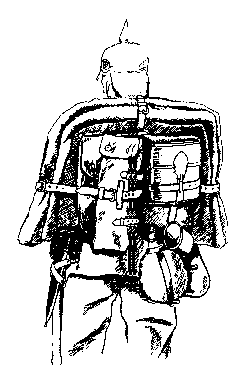
Cavalry Backpack (PackTaschen)
Appearing in late 1915, the cavalry pack was converted from saddlebags.
It had a large rivet which allowed the bag to still be used as sadlebags
if needed.
Shelter Half. (Zeltbahn) The shelter
half will be of tan, grey, field grey, or ochre canvas. It will be
approximately 62 x 62 inches and have a center seam running the length
of the plane. There will be 4 large grommets (one at each corner), and
each of these will have 3 smaller grommets positioned around them. Additionally,
at the center of each side, there will be two small grommets separated
by approximately 3 inches. The shelter half will have 64metal dish
buttons, positioned back to back, on both sides around the outside hem;
these will be evenly spaced approximately 7.5 inches apart. There will
be a button hole at each button position.
Mess Kit (Kochgeschirr)
Mess kits will be WWI originals made of aluminum or steel.
They will be approximately 7.5 inches deep. Aluminum mess kits will
be painted a gloss black, deep olive, light gray, dark gray, or field grey.
Utensil. The eating utensil will consist of a fork and spoon. The handles of these will be riveted together so that the apparatus can be folded, fork on top, when not in use. It is somewhat shorter than that issued to infantry. It is carried in the pocket.
Drinking Cup. The drinking cup
will be oval, approximately 3.75 inches tall, and made of enameled steel
or aluminum. The steel version will have a metal handle attached
at the narrow edge opposite a small pouring spout; the aluminum version
will have folding wire handles on one side only.
ACCESSORIES. Personal accessories
must either be of period origin, or an accurate representation of period-styled
items. As such, they must not obviously be constructed of materials
or in colors/finishes (e.g., fluorescent orange plastic) not available
in the 1914-18 timeframe. Authentic items, including foodstuffs,
must be removed from modern packaging, or the packaging must be modified
to look period, before any item is used. Care will be taken to ensure
accessories not only appear period, but accurately reflect European design
and styling.
Officer's Standards
TBA
Horse Equipment Standards
TBA (@ 1 September 2001)
GROOMING STANDARDS
HAIR. The hair will be cut so as not to touch the collar or tops of the ears. The sides and back will be tapered. Long top hair is not permitted, nor is the bunching of the hair to hide it beneath headgear
MUSTACHES. Mustaches are permitted. Beards have not been documented with the 8. Kurassiers, but, for now, are assumed to be acceptable. They will not be more than 2 inches long. Mustaches will be kept short or groomed (waxed) into a "handlebar" shape; "toothbrush" mustaches are not permitted. Those not wearing beards will display no more than one day's growth of beard
SIDEBURNS. Sideburns, for those not wearing a beard, will not extend below the top of the tragus (the prominent, pointed bump in front of the external opening of the ear)
Definitions
Drab: Any of the series of mid to light green and brown shades known in contemporary fashion as "earth-tones," including the khaki color from which US and UK uniforms were manufactured during the Great War.
Ersatz: German term for "substitute." Based on economic conditions, the Germans were forced to produce many items from materials other than those of which they had been manufactured before the war. Some of more common substitutes follow:
Brass, copper, and tombac; steel; pot metal; iron; pewter
Leather; cotton duck; linen; cotton webbing; Preßstoff (pressed
cardboard); papier mâché
Cloth; paper cloth
Field Grey: A warm, muted green color with a distinct grayish, brownish-grey, or blue-grayish tinge. Worn by the bulk of German forces during the Great War.
Slate Grey: A deep charcoal grey color used only for the production of overcoats and trousers in the German Army.
Tombac: An alloy essentially of copper and zinc and sometimes
tin or arsenic.
Sources of Supply: Any source may be used for obtaining the uniforms and equipment you will need to assemble the correct impression. All items must meet the standards established above and detailed in the specimen items in the photos. Please understand they are minimum standards and by no means should be considered the last authority on Imperial German uniforms and equipment.
Suppliers
GreatWar Militaria: A professional business that caters to collectors and reenactors alike. Please specify KURASSIERS when you order. Otherwise, you may receive a green piped infantry tunic . . . Most items they sell meet, or exceed, standards, but please . . . before you deviate from the list (and standards above) consult your mentor !
Regimental Lace (Litzen) available only through the unit.
Early War Kurassier Helmet available from IMA